Field Way Industrial Estate Buildings to Be Demolished
To be replaced by new development reaching up to seven storeys
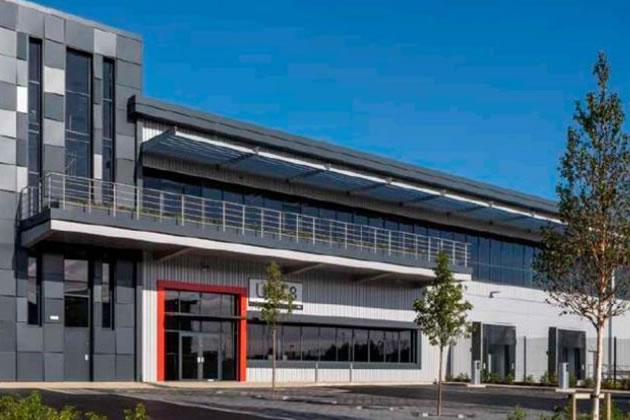
CGI of planned building at Greenford Industrial Estate. Picture: SERGO
April 12, 2026
Proposals for the partial redevelopment of a Greenford industrial estate have been approved.
Councillors on the Ealing Council Planning Committee voted in favour of the plans on Wednesday (April 8). Part 1B of the Greenford Industrial Estate on Field Way will be demolished and replaced with up to 15,000 square metres of modern industrial floorspace alongside ancillary offices.
The floorspace will be slightly reduced from the current 15,187 square metres to a maximum of 15,000 square metres. However the new units will be taller, reaching up to seven storeys – the tallest building is currently four storeys high.
The existing estate currently has four industrial blocks which were built in 1965. Although, over 70 per cent of these blocks are currently empty.
The proposal will demolish these ageing units and replace them with blocks fit for modern industrial work in the hope of revitalising the mostly empty estate. It is expected that by attracting new businesses, between 214 and 416 full-time jobs could be created.
The new estate has been designed as a zero-carbon development that will use air source heat pumps to heat the offices in the winter. There will also be a ‘green buffer zone’ along the Grand Union Canal. This has been designed to create a green frontage to the site and pushes the taller buildings further back to minimise the visual impacts.
The plans show the site will provide between 95 and 97 parking spaces and 28 HGV spaces. Both Transport for London (TfL) and Ealing Council Transport Services described this as an unjustified “overprovision”.
During the meeting, Cllr Miriam Rice raised a concern that due to the site operating 24/7, restricting parking could cause overspill onto nearby residential roads. To address both concerns, the developer must justify the need for up to 97 car parking spaces and put together a car parking management plan.
The site is currently dominated by buildings with few trees and “low quality” shrubs; 14 trees will be felled, however they will be replaced with 69 new trees, resulting in a biodiversity net gain of 63 per cent.
The developer has agreed to pay £383,355 in Section 106 contributions. This will be used towards improving the public realm and air quality, alongside local employment and training initiatives.
All councillors present voted in favour of the development.
Philip James Lynch - Local Democracy Reporter
Like Reading Articles Like This? Help Us Produce More This site remains committed to providing local community news and public interest journalism. Articles such as the one above are integral to what we do. We aim to feature as much as possible on local societies, charities based in the area, fundraising efforts by residents, community-based initiatives and even helping people find missing pets. We've always done that and won't be changing, in fact we'd like to do more. However, the readership that these stories generates is often below that needed to cover the cost of producing them. Our financial resources are limited and the local media environment is intensely competitive so there is a constraint on what we can do. We are therefore asking our readers to consider offering financial support to these efforts. Any money given will help support community and public interest news and the expansion of our coverage in this area. A suggested monthly payment is £8 but we would be grateful for any amount for instance if you think this site offers the equivalent value of a subscription to a daily printed newspaper you may wish to consider £20 per month. If neither of these amounts is suitable for you then contact info@neighbournet.com and we can set up an alternative. All payments are made through a secure web site. One-off donations are also appreciated. Choose The Amount You Wish To Contribute. If you do support us in this way we'd be interested to hear what kind of articles you would like to see more of on the site – send your suggestions to the editor. For businesses we offer the chance to be a corporate sponsor of community content on the site. For £30 plus VAT per month you will be the designated sponsor of at least one article a month with your logo appearing if supplied. If there is a specific community group or initiative you'd like to support we can make sure your sponsorship is featured on related content for a one off payment of £50 plus VAT. All payments are made through a secure web site. |