National Recognition for Ealing Hospital's Luxmi Dhoonmoon
Wins BAME Nurse of the Year for pioneering work on pressure ulcer detection
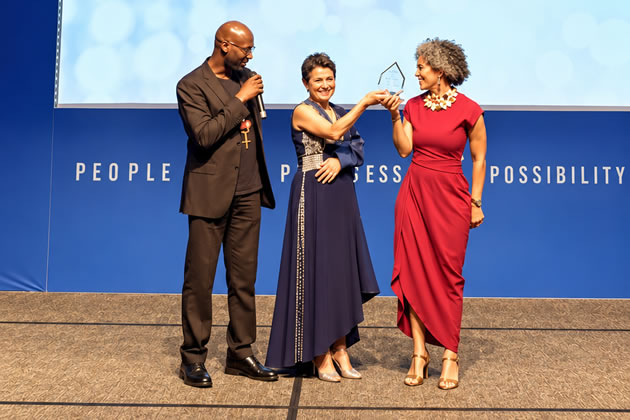 Luxmi receives her award at the gala event in London
September 22, 2026
An Ealing nurse whose research is reshaping how pressure ulcers are identified in Black and Asian patients has been named BAME Nurse of the Year, recognising a clinical innovation that is already changing practice across London North West University Healthcare NHS Trust.
Luxmi Dhoonmoon, a nurse consultant in Tissue Viability at Ealing Hospital, received the award at a gala event in London celebrating the achievements of Black, Asian and Minority Ethnic staff working across the health service. Her recognition follows a year in which she was shortlisted for both BAME Nurse of the Year and Trailblazer in Inclusion Excellence, highlighting the growing impact of her work.
Luxmi’s project began with a question that had troubled her for some time: why were so many patients from ethnic minority backgrounds arriving with late-stage pressure ulcers that had not been spotted earlier? Pressure ulcers can progress rapidly if missed, and in severe cases can expose or affect underlying bone, causing pain, infection and long-term complications.
She realised that the earliest warning sign — subtle changes in skin colour — was being overlooked because clinical guidance had historically been based on lighter skin tones. As she put it, “Sometimes things are so obvious we overlook them,” reflecting on the moment she recognised that darker skin was masking the first visual cues of tissue damage.
Her response was practical and straightforward: a skin tone card showing a graduated range of skin colours from light to dark, designed to help nurses and healthcare assistants assess early changes more accurately. Every member of the nursing and healthcare assistant workforce at LNWH Trust has now been issued with the card, embedding the tool directly into daily clinical practice.
The impact has been immediate. Staff report greater confidence in identifying early-stage pressure damage, and patients who might previously have been at risk of late diagnosis are now receiving earlier intervention. Dhoonmoon is also exploring whether the card could help clinicians identify early signs of cellulitis, a bacterial skin infection that can present differently on darker skin.Like Reading Articles Like This? Help Us Produce More This site remains committed to providing local community news and public interest journalism. Articles such as the one above are integral to what we do. We aim to feature as much as possible on local societies, charities based in the area, fundraising efforts by residents, community-based initiatives and even helping people find missing pets. We’ve always done that and won’t be changing, in fact we’d like to do more. However, the readership that these stories generates is often below that needed to cover the cost of producing them. Our financial resources are limited and the local media environment is intensely competitive so there is a constraint on what we can do. We are therefore asking our readers to consider offering financial support to these efforts. Any money given will help support community and public interest news and the expansion of our coverage in this area. A suggested monthly payment is £8 but we would be grateful for any amount for instance if you think this site offers the equivalent value of a subscription to a daily printed newspaper you may wish to consider £20 per month. If neither of these amounts is suitable for you then contact info@neighbournet.com and we can set up an alternative. All payments are made through a secure web site. One-off donations are also appreciated. Choose The Amount You Wish To Contribute. If you do support us in this way we’d be interested to hear what kind of articles you would like to see more of on the site – send your suggestions to the editor. For businesses we offer the chance to be a corporate sponsor of community content on the site. For £30 plus VAT per month you will be the designated sponsor of at least one article a month with your logo appearing if supplied. If there is a specific community group or initiative you’d like to support we can make sure your sponsorship is featured on related content for a one off payment of £50 plus VAT. All payments are made through a secure web site. |