Greene King Confirms Intention to Sell The Ballot Box Pub
Historic Greenford venue might struggle to find a buyer
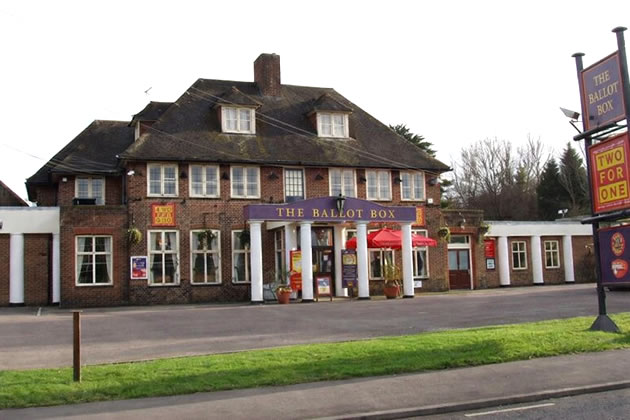
The Ballot Box on Horsenden Lane North. Picture: Facebook
|
May 7, 2026
After nearly three centuries of serving the local community — first as a haunt for canal bargees, then as a family pub for generations of Greenford residents — The Ballot Box has called time.
Following the announcement that it was to close, Greene King, which it acquired the freehold when it purchased the Spirit Group of pubs, has now confirmed its intention is to sell the site.
The last pint was pulled at The Ballot Box on Horsenden Lane North on Sunday 26 April. The closure of the pub — one of three in the immediate Greenford and Perivale area to shut its doors in quick succession — has triggered a wave of community anger, and a determined campaign to ensure that the building's future remains as a pub, not as housing.
Local resident Alex Nieora has written to Greene King demanding answers about the freeholder's intentions. Greene King's response, so far, has been brief. The company confirmed to EalingToday.co.uk, "Following the closure of the Ballot Box in Greenford, we can confirm the pub will be marketed for sale in the coming weeks."
The building that stands today on Horsenden Lane North dates from the 1930s, when it was a Benskins house, but the original Ballot Box stood at the other side of Horsenden Hill near the canal since at least 1726.
The Ballot Box name goes back to that earlier pub on Horsenden Lane, built around 1867 near the canal. It was used by barge workers as both a local pub and a polling station, which is where the name came from. The original building was demolished in 1943, with the current pub later opening further up the road and keeping the name.
The current building has served successive generations as a large family pub — home to a Wacky Warehouse soft play centre, popular with local families, and latterly operating under Greene King's Hungry Horse brand.
The Ballot Box does not close in isolation. Mr. Nieora's letter notes that The Railway Inn by Greenford Underground station closed just the week before, and that The Black Horse on Oldfield Lane North shut three years ago.
According to figures from the British Beer & Pub Association (BBPA), there were 60,800 pubs in Britain in 2000. The UK has now lost over 16,000 of them since then — a decline of more than a quarter. The BBPA has warned that the UK could see more than one pub closure per day throughout 2025, following 350 net closures in 2024. Business rates are cited as a key driver behind the trend, alongside higher operating costs, energy prices, and tax hikes.
Greene King's annual results revealed a £147 million pre-tax loss in 2024, with chief executive Nick Mackenzie slamming the "perfect storm" of rising inflation and employment costs. Under the current system, business rates for pubs are calculated using "fair maintainable turnover" — a measure of how much a pub should sell annually based on its location and capacity, not what it actually earns, leaving many loss-making pubs saddled with large tax bills regardless of their financial performance.
From 1 April 2026, the National Living Wage rose by 4.1% to £12.71 per hour. The April 2025 Budget also increased employer National Insurance contribution rates, and those increases compounded further in 2026. The hospitality and leisure business rates relief introduced during Covid was not extended into 2026/27; that relief had been worth approximately £1.4bn across the sector, and its removal, combined with wage increases, represents a simultaneous squeeze from both sides of the profit and loss account.
In March 2026, Greene King confirmed a major shake-up involving 150 pubs being put up for sale and 20 permanent closures across its estate. The Ballot Box appears to be among the 150 earmarked for sale. Industry bodies have warned of a potential 76% rise in pub business rates by 2028/29, a figure that reflects the severity of the financial cliff edge facing the sector.
The Ballot Box site on Horsenden Lane North is a sizeable plot with substantial car parking, set in a residential area with good transport links. For a developer eyeing residential conversion, it would look attractive. Mr Nieora's letter is blunt: "It would be unacceptable and a source of anger for local residents if this building is sold and redeveloped into flats."
The good news is that the planning rules around pub conversions have been significantly strengthened since 2017. Since 23 May 2017, any change of use or demolition of a pub — apart from changing the way a pub operates to include greater dining use, and back again — now requires full planning permission, regardless of whether a pub has been listed as an Asset of Community Value. This means that a developer cannot simply flip The Ballot Box into flats or a supermarket under permitted development rights. They would have to apply to Ealing Council for planning permission, and the council would have to decide that a pub at the site was unviable.
A key tool available to local residents is the Assets of Community Value (ACV) regime under the Localism Act 2011. If a pub is listed as an ACV and the owner decides to sell, they must inform the local authority of their intention to do so. The community then has up to six weeks to express an interest in becoming potential bidders to buy the asset. Once an expression of interest has been received, a further four-and-a-half month pause in the sale process is triggered, giving potential bidders a total of six months to raise the funds required to purchase the asset.
The owner is under no obligation to sell to the community group at the end of that period — they may sell to whoever they choose at whatever price — but the moratorium buys time and raises the public profile of the asset, making it harder for a developer to move quickly.
Further legal changes are on the way. The English Devolution and Community Empowerment Bill, introduced in July 2025, proposes to strengthen community leverage by making "local ownership of pubs, shops and social hubs easier," broadening the scope of ACVs and expanding the moratorium period on sale. These changes are not yet in force, but they signal the direction of travel.
ACV listing also has a crossover with local heritage lists. Once a building is on a local heritage list, changes that might affect its special interest must be managed through the planning system. Given the Ballot Box's documented history stretching back to at least 1726 — and the 1930s building's own historical context as a Benskins house — there may be a case for arguing that it should be considered a non-designated heritage asset.
By late 2015, of about 860 pubs across the country which had registered as ACVs, only twelve had been acquired by groups under the community right to bid. The protections exist, but exercising them demands resources and determination.
The intention to sell having been confirmed, local residents and any community group wishing to assert the right to bid would need to act immediately: nominating the pub as an ACV with Ealing Council, organising formally as a qualifying group, and beginning the process of exploring financing options through bodies such as the Plunkett Foundation or Locality, both of which support community asset purchases.
Like Reading Articles Like This? Help Us Produce More This site remains committed to providing local community news and public interest journalism. Articles such as the one above are integral to what we do. We aim to feature as much as possible on local societies, charities based in the area, fundraising efforts by residents, community-based initiatives and even helping people find missing pets. We’ve always done that and won’t be changing, in fact we’d like to do more. However, the readership that these stories generates is often below that needed to cover the cost of producing them. Our financial resources are limited and the local media environment is intensely competitive so there is a constraint on what we can do. We are therefore asking our readers to consider offering financial support to these efforts. Any money given will help support community and public interest news and the expansion of our coverage in this area. A suggested monthly payment is £8 but we would be grateful for any amount for instance if you think this site offers the equivalent value of a subscription to a daily printed newspaper you may wish to consider £20 per month. If neither of these amounts is suitable for you then contact info@neighbournet.com and we can set up an alternative. All payments are made through a secure web site. One-off donations are also appreciated. Choose The Amount You Wish To Contribute. If you do support us in this way we’d be interested to hear what kind of articles you would like to see more of on the site – send your suggestions to the editor. For businesses we offer the chance to be a corporate sponsor of community content on the site. For £30 plus VAT per month you will be the designated sponsor of at least one article a month with your logo appearing if supplied. If there is a specific community group or initiative you’d like to support we can make sure your sponsorship is featured on related content for a one off payment of £50 plus VAT. All payments are made through a secure web site. |