Watchdog Finds Fault in Council's Handling of Lammas Park SuDS Project
Concludes errors unlikely to have changed decision to proceed
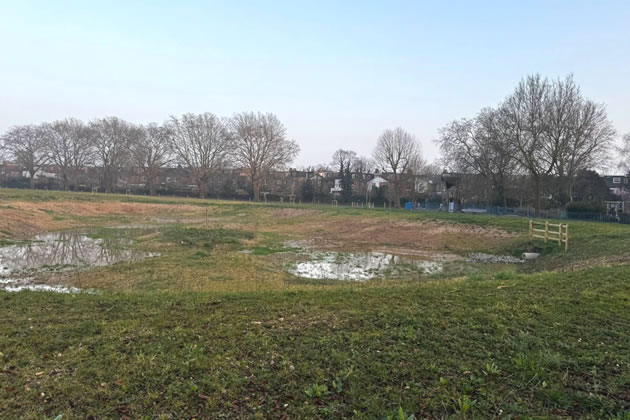
One of the basins in the drainage scheme. Picture: Ealing Wastelands Group/Facebook
March 25, 2026
A report by the Local Government and Social Care Ombudsman has found fault in the way Ealing Council handled a planning application for flood prevention works at Lammas Park. However, it was concluded that the identified errors were unlikely to have changed the overall decision to proceed with the scheme.
The decision, made in January but only published this week, upheld a complaint from a local resident, referred to as Mr B, concerning the approval and delivery of a sustainable drainage (SuDS) project involving attenuation basins and swales designed to reduce surface water flooding.
At the centre of the Ombudsman’s findings was the council’s failure to properly consider what would happen to soil excavated during construction. Although planning documents indicated the material would be redistributed within the park, this was not adequately addressed in the officer’s report, despite its potential impact on ground levels and the character of the open space.
In practice, the soil was spread across parts of the park following approval, raising ground levels and, in some cases, extending beyond the approved planning boundary. These elements were not authorised at the time and later required a separate planning application to regularise the works.
The Ombudsman also found that the scheme had been incorrectly treated as a minor development. While the physical footprint of the drainage features was relatively small, the wider extent of the works—covering a site of around five hectares when soil redistribution was taken into account—meant it should have been classified as a major development. This misclassification meant the application was not publicised as widely as regulations require, limiting opportunities for public engagement.
Further issues identified included inaccuracies in the officer’s report, notably a claim that the Chair of the Planning Committee had been consulted when this had not occurred, and delays in the council’s handling of the resident’s complaint.
However, the Ombudsman did not uphold all aspects of the complaint. It found no fault in the council’s assessment of the need for flood mitigation, noting that the scheme was supported by technical evidence and backed by agencies including the Environment Agency and Thames Water. It also concluded that the council was entitled to decide that a formal flood risk assessment was not required and that the scheme did not need referral to the Greater London Authority.
The report states that, on the balance of probabilities, the original planning application would likely still have been approved even if the identified procedural faults had not occurred. Nonetheless, those failings led to unauthorised works, disruption for park users and what the Ombudsman described as avoidable frustration and uncertainty about the fairness of the decision-making process.
The council has accepted the findings and agreed to apologise to the complainant. It has also committed to reviewing its procedures, including improving quality control of officer reports, addressing the issues with relevant staff, and increasing transparency and consultation on projects that may significantly affect residents.
In a statement, the council said the principle of the flood mitigation scheme had received cross-party support and stressed the importance of the works in addressing local flood risk. A spokesperson acknowledged that “mistakes were made along the way” and apologised for the failings identified, adding that a subsequent planning application had addressed many of the concerns raised and resulted in a more comprehensive scheme.
The council also pointed to ongoing improvements at the site, including the phased removal of temporary fencing to reopen more of the park to the public, alongside further planting and safety measures.
The findings have prompted criticism from opposition councillors. Gary Malcolm, leader of the Liberal Democrat group, described the report as “damning” and argued that the handling of the scheme had undermined public confidence. He has called for the resignation of Cllr Paul Driscoll, the cabinet member responsible, and for a wider review of the project.
Like Reading Articles Like This? Help Us Produce More This site remains committed to providing local community news and public interest journalism. Articles such as the one above are integral to what we do. We aim to feature as much as possible on local societies, charities based in the area, fundraising efforts by residents, community-based initiatives and even helping people find missing pets. We’ve always done that and won’t be changing, in fact we’d like to do more. However, the readership that these stories generates is often below that needed to cover the cost of producing them. Our financial resources are limited and the local media environment is intensely competitive so there is a constraint on what we can do. We are therefore asking our readers to consider offering financial support to these efforts. Any money given will help support community and public interest news and the expansion of our coverage in this area. A suggested monthly payment is £8 but we would be grateful for any amount for instance if you think this site offers the equivalent value of a subscription to a daily printed newspaper you may wish to consider £20 per month. If neither of these amounts is suitable for you then contact info@neighbournet.com and we can set up an alternative. All payments are made through a secure web site. One-off donations are also appreciated. Choose The Amount You Wish To Contribute. If you do support us in this way we’d be interested to hear what kind of articles you would like to see more of on the site – send your suggestions to the editor. For businesses we offer the chance to be a corporate sponsor of community content on the site. For £30 plus VAT per month you will be the designated sponsor of at least one article a month with your logo appearing if supplied. If there is a specific community group or initiative you’d like to support we can make sure your sponsorship is featured on related content for a one off payment of £50 plus VAT. All payments are made through a secure web site. |