Ealing Broadway Safety Inquiry Finds Ineffective Risk Management
Woman dragged along platform after hand was caught in train doors
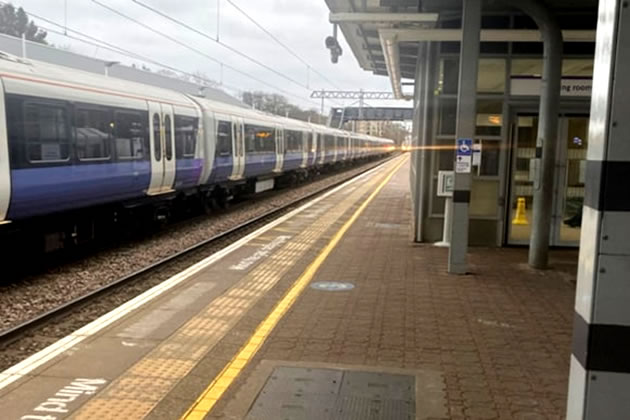
Ealing Broadway station platform. Picture: RAIB
March 4, 2026
A safety investigation has found that a passenger was dragged along the platform at Ealing Broadway after their hand became trapped in the doors of a departing Elizabeth line train, prompting a series of recommendations aimed at preventing similar incidents across the network.
The Rail Accident Investigation Branch (RAIB) published its findings this week, more than a year after the accident on 24 November 2024, when the westbound train departed while the passenger’s hand remained caught in the closing doors. The person was forced to run alongside the train for around 12 metres before being pulled clear by another passenger and a member of platform staff. It is believed they suffered minor injuries, although investigators have been unable to contact them to confirm this.
RAIB concluded that the accident happened because the train driver closed the doors while passengers were still boarding and alighting, and because the passenger attempted to board as the doors were closing. The train’s door system did not detect the trapped hand, and the driver was unaware of the situation before initiating departure.
Investigators also found that measures used by MTR Elizabeth line, the operator at the time, to manage the risk of “trap and drag” incidents at Ealing Broadway were not effective. A possible contributing factor was Network Rail’s failure to carry out a sufficiently thorough risk assessment when relocating a waiting room on the platform, which may have affected sightlines or passenger flow.
Although not a contributory factor to this case, RAIB highlighted several safety-critical weaknesses exposed by the incident. Communications between platform staff, the driver, the signaller and the duty control manager did not lead to a shared understanding of what had happened. The handheld public-address device used on platform 3 suffered from poor connectivity, reducing its effectiveness. Investigators also found that MTR Elizabeth line had missed opportunities to ensure internal safety recommendations were properly tracked and completed.
The report further noted that industry standards for testing and commissioning driver-only operation (DOO) CCTV do not require a realistic platform environment during testing, potentially limiting the system’s ability to reflect real-world risks.
RAIB has issued five recommendations following the investigation. The first, directed at the new Elizabeth line operator GTS Rail Operations, calls for improved understanding and control of trap-and-drag risks. Transport for London has been asked to enhance the platform-train interface views available to drivers via DOO CCTV and to evaluate new technologies that could further reduce the risk of passengers being trapped and dragged. The Rail Safety and Standards Board has been urged to update industry standards for DOO CCTV to reflect current best practice, and Network Rail has been told to ensure that any changes to station infrastructure are properly assessed for safety impacts.
Two learning points were also identified: the importance of effective safety-critical communication, and the need for drivers to have sufficient time to complete final platform-train interface checks before departure.
Like Reading Articles Like This? Help Us Produce More This site remains committed to providing local community news and public interest journalism. Articles such as the one above are integral to what we do. We aim to feature as much as possible on local societies, charities based in the area, fundraising efforts by residents, community-based initiatives and even helping people find missing pets. We've always done that and won't be changing, in fact we'd like to do more. However, the readership that these stories generates is often below that needed to cover the cost of producing them. Our financial resources are limited and the local media environment is intensely competitive so there is a constraint on what we can do. We are therefore asking our readers to consider offering financial support to these efforts. Any money given will help support community and public interest news and the expansion of our coverage in this area. A suggested monthly payment is £8 but we would be grateful for any amount for instance if you think this site offers the equivalent value of a subscription to a daily printed newspaper you may wish to consider £20 per month. If neither of these amounts is suitable for you then contact info@neighbournet.com and we can set up an alternative. All payments are made through a secure web site. One-off donations are also appreciated. Choose The Amount You Wish To Contribute. If you do support us in this way we'd be interested to hear what kind of articles you would like to see more of on the site – send your suggestions to the editor. For businesses we offer the chance to be a corporate sponsor of community content on the site. For £30 plus VAT per month you will be the designated sponsor of at least one article a month with your logo appearing if supplied. If there is a specific community group or initiative you'd like to support we can make sure your sponsorship is featured on related content for a one off payment of £50 plus VAT. All payments are made through a secure web site. |